Showing posts with label photography. Show all posts

8.4.22

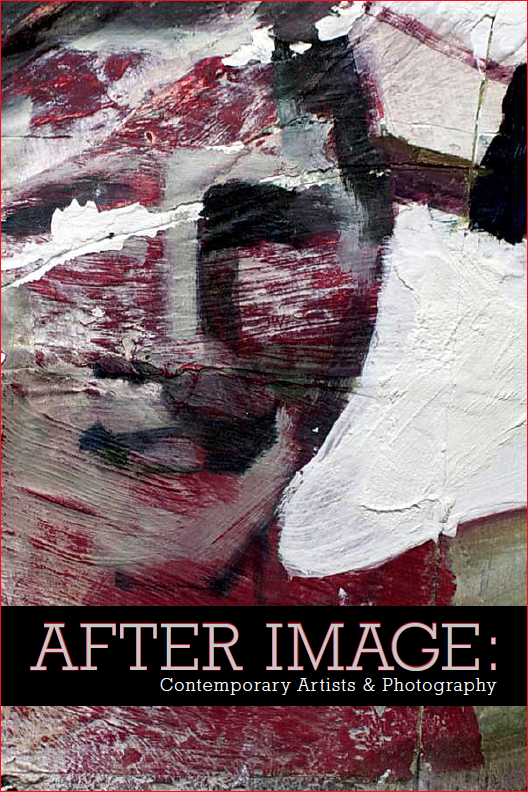
 After Image

Contemporary Artists & Photography

However the image enters
its force remains within
my eyes
rockstrewn caves where dragonfish
evolve
wild for life, relentless and acquisitive
learning to survive
where there is no food
my eyes are always hungry
and remembering
however the image enters
its force remains...
Audre Lorde,
Afterimages, (1981)

April 4 - May 29, 2015

The first photographers were inventors, scientists or those mechanically inclined—the grinding of lenses and the chemical processes were often of more interest to them than the artfulness of the images created. Artful or not, it was immediately apparent how extraordinarily effective photography was at depicting with accuracy the world in front of the camera. Artists became captivated by the new technology. They could easily record a portrait, a view, or a moment in time and revisit it as reference material for their work. Edgar Degas was among the 19th century painters who embraced photography. It’s possible to infer the influence of the technology on his painting from the cropped figures and framing of his subjects.
Edgar Degas, A Ballet Seen from the Opera Box, c. 1884,
pastel on paper, 25.75 x 19.875 inches.

Ever since Nicéphore Niépce, Hércules Florence and Henry Fox Talbot developed fixable photography in the 19th century, there has been debate whether the medium could evolve beyond its use as a documentary tool. The Pictorialism movement of the late 1800s to early 1900s aimed to bring respect to photography as an art form. Pictorialist works would often be soft focus, toned images with the surfaces enhanced to mimic qualities of drawing or engraving. Edward Steichen was a Pictorialist who had trained as a painter. Along with Alfred Stieglitz he opened the Little Galleries of the Photo-Secession. The gallery and Stieglitz’ magazine Camera Work actively promoted photography as a fine art. 

As a young man, Paul Strand visited Stieglitz’ gallery and was inspired by the Pictorialists. Strand later introduced greater abstraction into his compositions and has been credited with bringing Modernism into photography in the 20th century. Alfred Stieglitz followed soon after with his “Equivalents” series, which he insisted were equivalent to the abstract paintings of Wassily Kandinsky. By the 1960s, Vito Acconci was using photography as a means to convey his conceptual ideas of time and space, while Robert Rauschenberg was blanketing his work with photo transfers devising a photomechanical texture the content of which had little to do with the meaning of the work itself. 

Artists have actively engaged with photography in innovative ways since its invention, but it wasn’t until the 1970s that Sam Wagstaff, mentor to Robert Mapplethorpe, changed how it was perceived and valued as art. Wagstaff recognized that photography was undervalued.He began to collect American, British and French photography from the 19th century and eventually amassed an extraordinary collection. He is credited with establishing the modern market for collecting fine art photography. Previously, photography careers had been almost exclusively tied to the media—journalism and advertising. The collecting world had finally caught
up to Pictorialist assertions.

It was the Postmodern 1980s that saw an increased number of visual artists trained as painters fully embracing photography as a medium. Cindy Sherman staged her photographs and challenged the primacy of documentary, fashion and other types of photographic conventions. Jan Groover began juxtaposing images that together had more meaning than a single photograph. At the same time, there was a rise in interest in antique processes, inexpensive cameras and the distortions they made, and prints that would have made Ansel Adams weep with despair. 

Photography now is more simple and accessible than ever. With our camera phones at the ready we’re all perpetual image makers and sharers. We’ve gone from the alchemical dimness of “View From the Window at Le Gras”— the oldest surviving camera photograph, by Nicéphore Niépse, c. 1826—to the vivid, relentless static of our social media feeds. 

After Image is showcasing visual artists who are celebrating the photographic image, but are using it in ways that expand it as an expressive medium and are forcing it to conform to their idea of what a photograph can be. 

Returning to the beginnings of mechanical reproduction in art, Marsha Goldberg, “Smoke Billows from the Scene of a Blast in Bagdad,” and Joey Parlett, “Manassas,” render it back into a unique work of art through carefully distilling the photographic tones into a drawing. 

Nina Meledandri, “#915-3852,” and Kirsten Nash, “Bouquet Installed with Print Display,” find a conceptual relatedness between photography and painting by juxtaposing painting with the photograph, each informing the other and creating new meaning for both. 

Ross Bennett Lewis, “Missing,” like Sherrie Levine, takes a photograph of photographs. Lewis transforms the portraits of victims of 9/11 into a memento mori, a still life of a tragic moment of loss.
 
Nicéphore Niépce, View from the Window at Le Gras, c. 1826, photograph on pewter
plate, 6.4 x 8 inches. Below is a version enhanced by Helmut Gernsheim, c. 1952.


Bill Westheimer, “Las Vingeles” takes a small edge of a photograph and by enlarging it to extreme proportions, evokes surreal, panoramic landscapes that cause us to question our idea of place. 

Mary Pinto, “Plant,” Brett Wallace, “Organic #1” and Julie McHargue, “AP 1” to “3,” use the photograph for its color and texture to build three-dimensional objects that transforms the static source material into something visually kinetic. 

Julia Rooney, “I did a series in very hot August,” and Dennis Santella, Untitled, from “Electric Dreams,” explore the plethora of images that have inundated our lives with the popularity of the internet and digital photography. Rooney co-opts the low-resolution screenshots from Skype conversations and transforms them into oil sketches, imbuing them with more personality and meaning than was apparent in the small, deadpan digital captures. Santella explores our increasing fascination with technology and images by capturing a bit-mapped still from a digital video transmission and questions the information our culture is currently receiving. 

Emmy Mikelson, “Elevation no. 24,” takes us directly into the future with her non-object image. The idea of the tangible photograph as an object has been replaced by an image that exists only in digital space. No need for permanence at all, except for the saving of an electronic file. 

Each of the artists in After Image are deconstructing the idea of what a photographic image can be, rebuilding it into something new. By inputting their unique talent into these works, we discover that image making has a means of expression as rich and mutable as painting and sculpture. The photograph serves the visual artist as another powerful weapon in their arsenal of expression.

Arthur Bruso
Raymond E. Mingst
Curators


Artists


 This exhibition was our inaugural exhibition as curators of Art House Gallery in Jersey City. 


29.12.15

Penumbra

AUGUST 12 – SEPTEMBER 13, 2015
Photographs by Arthur Bruso


Arthur Bruso has captured, in the photographs of Penumbra, that particular moment when we enter a dark room and strain to see. The images are almost completely black. A sense of place is occasionally suggested with a classical sculpture that seems to glow, or a clerestory revealed with a spot of light. The darkness feels solitary, populated only by an occasional marble figure. If anyone were to appear it would be a shock—unexpected in the moment you’re still gaining your bearings.

Once we’ve added up the hints, we can ascertain that the places visited here are the streets and cathedrals of Rome. Absent, other than the details, is sentimentality. When confronted with the everyday marvels of Rome it’s easy to work purely in service of the romance of the place. To either focus on its grandeur or charm. When a subject has been photographed so relentlessly it’s a challenge not to fall prey to conventions. Bruso reignites the possibility that there are still discoveries to make.

The images sometimes appear haphazard, as if we’re glancing around trying to locate an identifiable detail. This quality gives immediacy to the works, they’re in the process of disclosure. The prints themselves are beautifully produced. The blacks have a matte charcoal-like richness. The texture complements the idea that we’re feeling our way along in these cool, silent, echoing spaces. Raymond E. Mingst

A Few Questions for Arthur Bruso

REM: You have a vast catalogue of photographs. You’ve printed hundreds and hundreds of images— these images span almost your entire life. You even have the first images you took with the first camera you received at 6 years old. Something we’ve talked about is how all of these photos are in play in your art practice. For example, in any given show we may be looking at an image you took as a very young person or an image you may have taken just last week. Confounding documentary considerations, like time and place, is a constant in your work. With that, how would you say your imagery has evolved over time?
AB: I’ve gotten better at using a camera. I believe that each camera “sees” differently. I have become more adept at exploiting those differences and using them to advantage in my work. I have also become less and less interested in the figure – I still have figurative work in my backlog, but in my newer work, I find I am more drawn to the landscape or inanimate objects. When I was younger (in college until after graduate school) I had the notion that I would be a Photographer who would make a Difference and a lot of my work was social commentary. These days, I find I am more interested in more esoteric ideas.

REM: For me, looking through the many boxes of your prints and shaping a show is a fascinating process. Identifying a theme or unifying element, selecting particular works and then writing about it, I feel a sense of authorship. However, it’s a collaborative process. Can you speak to what the process is like for you?
AB: A photographer can amass a large body of work in a short time, even when they are like me and are constantly editing – I never print every frame of film I expose. The curator can help make sense of the boxes of prints. I have my own ideas of what I want, but a curator shapes an exhibition which needs a cohesiveness that I may not have in my date defined boxes. Collaborating can be interesting in that way because I get to see my work through outside eyes. It can be frustrating as well, when there is a reinterpretation of the work that was never intended, but in the end, it becomes a back and forth, give and take. The curators I work with only want to show my work in its best light and for that I need to trust them.

REM: While you often talk about the aspects of your photos that aren’t documentary — composition, anomalies of the process that appeal to you, etc. — is nostalgia ever activated for you? Do you think about the when and where and what was going on in your life at the time you took the photo? Does your personal biography ever influence how you use your catalogue of images?
AB: Nostalgia is often a part of the work. I can remember the circumstances and my motivations for taking my first photographs. The image itself is often a trigger for me, and much of my work is about my experiences in a conceptual way.

REM: Can you speak more about that? How your work is about your experiences in a conceptual way…
AB: I don’t consciously plan to document my experiences in my work, but when I review it after it is complete I often see the connection. If you read the essays in my photo books, you will find that the photographic series relate to events in my life. The work may not actually portray what I discuss in the essay, but the essence is there.

REM: I referred to your “catalogue of images”. Is that how you would refer to them? Also, you keep each image in a plastic sleeve and those are kept in grey, archival storage boxes. Do you have a catalogue system so you can find particular images?
AB: I would call it a body of work. The organization is an evolving thing. My negatives I am bringing under control – or at least I have a system for them. My prints are more haphazard right now, but I am working on that.

30.8.14

Additional Narrative Possibilities


My October 2013 solo exhibition at Curious Matter.


Additional Narrative Possibilities

PHOTOGRAPHIC WORKS BY ARTHUR BRUSO
SPECIAL WEEKEND-LONG OPENING,OCTOBER 5 & 6, NOON TO 6PM


Wet Floor

Wet Floor, 8 X 10 inches, silver gelatin print


.


ARTHUR BRUSO dodges narrative at one turn and embraces it the next. He begins this dance by using every photograph he has ever taken as the raw material for his work. For example, he may reprint an image he captured at the age of seven or seventeen and juxtapose it with something he photographed last week. He may do this in response to the visual structure of the images––an interest in how the diagonal bands of light captured in one image are a variation on the shadows in another. However, history, and specifically Bruso’s own history of looking and examining is a considerable aspect of the work. His photographic practice is built upon a perpetual state of review, reassessment, and reprinting. Perhaps constant looking is the task of every visual artist. In the case of Bruso, that accumulation of looking manifests not just in the refinement of his vision, but also in a rich layering––a photographic pentimento.
Fair Midway
Fair Midway, 8 X 10 inches, color photograph.
Bruso doesn’t share the documentarian’s interest in the story behind the events, people, and buildings he shoots. He favors explorations in tone, color, composition and texture. In spite of this, we’re still confronted with a curiosity about the who, what, where. The question of whether Bruso is attempting to use his imagery as purely “abstract” becomes complicated by his occasional use of narrative accompaniment. In his 8 part series, “Association Sublimation,” over one hundred photographic works are presented along with essays that are remembrances and meditations. The images of “Association Sublimation” are sometimes unidentifiable blurs and streaks of light, yet they evoke a portrait and a sense of the artist’s journey. He essentially presents a self-portrait of the artist as a young man.


Construction Wires
Construction Wires, 8 X 10 inches, silver gelatin print.
Additional Narrative Possibilities is comprised of 26 photographs. Among images of shattered glass, boarded doorways, chain link fencing, and light glinting off wet asphalt is a single portrait. The head of a woman is clearly visible against a snowy backdrop while her body disappears into a triangle of shadow. Is the collection of images meant to evoke a life story, a psychological portrait, or a formal examination of color, tone, texture and shape? Additional Narrative Possibilities is an invitation to look with shifting perspectives and intention in mind. What questions are we compelled to ask ourselves as we view the images? What questions are we being nudged to consider by the artist?
East River Pilings, 8 X 10 inches, silver gelatin print.
The urge to construct a story from Bruso’s images may simply be the result of a sort of tarot-like symbolism that is an undercurrent in his work. One of the first exhibitions of Bruso’s photographs that I had curated began with my selecting a group of 20 or so images from his huge archive. The theme of portals emerged. I was captivated by the many variations on the theme––a gate, the iron door of a crypt, the front entrance to an abandoned building. However, Bruso balked at the grouping––and rightly so. The collection was too constrained. We rethought the selections and varied the subject matter. The new collection revealed surprising relationships among the individual works. Ultimately, it made for a richer, more intriguing exhibition.


Glass On The Ground
Glass On The Ground, 8 X 10 inches, color photograph.
We can certainly respond to the formal qualities of Bruso’s work. Alongside that appreciation we can’t seem to leave behind an impulse to decipher and assign meaning. His visual language includes images that lend themselves to symbolic interpretation. Describing this exhibition, in fact, might sound like a psychic’s reading: we see a broken rock, we see a path, we see a woman on the path engulfed in shadow, and then we see a shaft of light. How far do we take our interpretations of the narrative possibilities? Like a psychic reading we might find some satisfaction, an easing of anxiety about a particular nagging question by shaping some sort of story. But questions persist. And so, we return for more information. The enigmatic photographic explorations of Arthur Bruso also inspire repeated visits, and endless interpretation.
––Raymond E. Mingst, curator