Showing posts with label photographs. Show all posts

29.12.15

Penumbra

AUGUST 12 – SEPTEMBER 13, 2015
Photographs by Arthur Bruso


Arthur Bruso has captured, in the photographs of Penumbra, that particular moment when we enter a dark room and strain to see. The images are almost completely black. A sense of place is occasionally suggested with a classical sculpture that seems to glow, or a clerestory revealed with a spot of light. The darkness feels solitary, populated only by an occasional marble figure. If anyone were to appear it would be a shock—unexpected in the moment you’re still gaining your bearings.

Once we’ve added up the hints, we can ascertain that the places visited here are the streets and cathedrals of Rome. Absent, other than the details, is sentimentality. When confronted with the everyday marvels of Rome it’s easy to work purely in service of the romance of the place. To either focus on its grandeur or charm. When a subject has been photographed so relentlessly it’s a challenge not to fall prey to conventions. Bruso reignites the possibility that there are still discoveries to make.

The images sometimes appear haphazard, as if we’re glancing around trying to locate an identifiable detail. This quality gives immediacy to the works, they’re in the process of disclosure. The prints themselves are beautifully produced. The blacks have a matte charcoal-like richness. The texture complements the idea that we’re feeling our way along in these cool, silent, echoing spaces. Raymond E. Mingst

A Few Questions for Arthur Bruso

REM: You have a vast catalogue of photographs. You’ve printed hundreds and hundreds of images— these images span almost your entire life. You even have the first images you took with the first camera you received at 6 years old. Something we’ve talked about is how all of these photos are in play in your art practice. For example, in any given show we may be looking at an image you took as a very young person or an image you may have taken just last week. Confounding documentary considerations, like time and place, is a constant in your work. With that, how would you say your imagery has evolved over time?
AB: I’ve gotten better at using a camera. I believe that each camera “sees” differently. I have become more adept at exploiting those differences and using them to advantage in my work. I have also become less and less interested in the figure – I still have figurative work in my backlog, but in my newer work, I find I am more drawn to the landscape or inanimate objects. When I was younger (in college until after graduate school) I had the notion that I would be a Photographer who would make a Difference and a lot of my work was social commentary. These days, I find I am more interested in more esoteric ideas.

REM: For me, looking through the many boxes of your prints and shaping a show is a fascinating process. Identifying a theme or unifying element, selecting particular works and then writing about it, I feel a sense of authorship. However, it’s a collaborative process. Can you speak to what the process is like for you?
AB: A photographer can amass a large body of work in a short time, even when they are like me and are constantly editing – I never print every frame of film I expose. The curator can help make sense of the boxes of prints. I have my own ideas of what I want, but a curator shapes an exhibition which needs a cohesiveness that I may not have in my date defined boxes. Collaborating can be interesting in that way because I get to see my work through outside eyes. It can be frustrating as well, when there is a reinterpretation of the work that was never intended, but in the end, it becomes a back and forth, give and take. The curators I work with only want to show my work in its best light and for that I need to trust them.

REM: While you often talk about the aspects of your photos that aren’t documentary — composition, anomalies of the process that appeal to you, etc. — is nostalgia ever activated for you? Do you think about the when and where and what was going on in your life at the time you took the photo? Does your personal biography ever influence how you use your catalogue of images?
AB: Nostalgia is often a part of the work. I can remember the circumstances and my motivations for taking my first photographs. The image itself is often a trigger for me, and much of my work is about my experiences in a conceptual way.

REM: Can you speak more about that? How your work is about your experiences in a conceptual way…
AB: I don’t consciously plan to document my experiences in my work, but when I review it after it is complete I often see the connection. If you read the essays in my photo books, you will find that the photographic series relate to events in my life. The work may not actually portray what I discuss in the essay, but the essence is there.

REM: I referred to your “catalogue of images”. Is that how you would refer to them? Also, you keep each image in a plastic sleeve and those are kept in grey, archival storage boxes. Do you have a catalogue system so you can find particular images?
AB: I would call it a body of work. The organization is an evolving thing. My negatives I am bringing under control – or at least I have a system for them. My prints are more haphazard right now, but I am working on that.

30.8.14

Additional Narrative Possibilities


My October 2013 solo exhibition at Curious Matter.


Additional Narrative Possibilities

PHOTOGRAPHIC WORKS BY ARTHUR BRUSO
SPECIAL WEEKEND-LONG OPENING,OCTOBER 5 & 6, NOON TO 6PM


Wet Floor

Wet Floor, 8 X 10 inches, silver gelatin print


.


ARTHUR BRUSO dodges narrative at one turn and embraces it the next. He begins this dance by using every photograph he has ever taken as the raw material for his work. For example, he may reprint an image he captured at the age of seven or seventeen and juxtapose it with something he photographed last week. He may do this in response to the visual structure of the images––an interest in how the diagonal bands of light captured in one image are a variation on the shadows in another. However, history, and specifically Bruso’s own history of looking and examining is a considerable aspect of the work. His photographic practice is built upon a perpetual state of review, reassessment, and reprinting. Perhaps constant looking is the task of every visual artist. In the case of Bruso, that accumulation of looking manifests not just in the refinement of his vision, but also in a rich layering––a photographic pentimento.
Fair Midway
Fair Midway, 8 X 10 inches, color photograph.
Bruso doesn’t share the documentarian’s interest in the story behind the events, people, and buildings he shoots. He favors explorations in tone, color, composition and texture. In spite of this, we’re still confronted with a curiosity about the who, what, where. The question of whether Bruso is attempting to use his imagery as purely “abstract” becomes complicated by his occasional use of narrative accompaniment. In his 8 part series, “Association Sublimation,” over one hundred photographic works are presented along with essays that are remembrances and meditations. The images of “Association Sublimation” are sometimes unidentifiable blurs and streaks of light, yet they evoke a portrait and a sense of the artist’s journey. He essentially presents a self-portrait of the artist as a young man.


Construction Wires
Construction Wires, 8 X 10 inches, silver gelatin print.
Additional Narrative Possibilities is comprised of 26 photographs. Among images of shattered glass, boarded doorways, chain link fencing, and light glinting off wet asphalt is a single portrait. The head of a woman is clearly visible against a snowy backdrop while her body disappears into a triangle of shadow. Is the collection of images meant to evoke a life story, a psychological portrait, or a formal examination of color, tone, texture and shape? Additional Narrative Possibilities is an invitation to look with shifting perspectives and intention in mind. What questions are we compelled to ask ourselves as we view the images? What questions are we being nudged to consider by the artist?
East River Pilings, 8 X 10 inches, silver gelatin print.
The urge to construct a story from Bruso’s images may simply be the result of a sort of tarot-like symbolism that is an undercurrent in his work. One of the first exhibitions of Bruso’s photographs that I had curated began with my selecting a group of 20 or so images from his huge archive. The theme of portals emerged. I was captivated by the many variations on the theme––a gate, the iron door of a crypt, the front entrance to an abandoned building. However, Bruso balked at the grouping––and rightly so. The collection was too constrained. We rethought the selections and varied the subject matter. The new collection revealed surprising relationships among the individual works. Ultimately, it made for a richer, more intriguing exhibition.


Glass On The Ground
Glass On The Ground, 8 X 10 inches, color photograph.
We can certainly respond to the formal qualities of Bruso’s work. Alongside that appreciation we can’t seem to leave behind an impulse to decipher and assign meaning. His visual language includes images that lend themselves to symbolic interpretation. Describing this exhibition, in fact, might sound like a psychic’s reading: we see a broken rock, we see a path, we see a woman on the path engulfed in shadow, and then we see a shaft of light. How far do we take our interpretations of the narrative possibilities? Like a psychic reading we might find some satisfaction, an easing of anxiety about a particular nagging question by shaping some sort of story. But questions persist. And so, we return for more information. The enigmatic photographic explorations of Arthur Bruso also inspire repeated visits, and endless interpretation.
––Raymond E. Mingst, curator

10.6.12

Haunted Hallway


Haunted Hallway
3 photographs, vintage wallpaper, acrylic medium
each image 5" x 7"


Stairs can be dangerous places. My grandfather died from a fall down a flight stairs. While carrying a watermelon up the stairs, the leg brace he wore caught a tread and he lost his balance. My mother some years later fell down the same steps and survived with just two broken arms and a broken leg.  Was it a misstep or was the spirit of my grandfather now haunting those stairs? Ghosts are said to hang around the place of their tragedy, often inadvertently causing further mishaps. Or, perhaps it was some other demon cursing the stairs that was to blame for both disasters. We can only guess. Those stairs were no longer used
after my mother’s accident.
In folklore, the stairs of a house fall within the realm of transitional areas.  While a part of the house, they are not part of the living space. They exist in a twilight place, making them vulnerable points of attack for evil to invade. Like their attendant hallways, they connect rooms, but one does not live on them. Stairs are also full of corners and turns which collect negative energy. Because of this build up of negativity and vulnerability, there are rituals to keep the evil spirits at bay that may be lurking about to trip up an unsuspecting soul. Superstition advises when climbing stairs, that one should always keep ones hand on the railing and the railing should always be made of wood. Wood comes from trees and trees, since the time of the ancient Greeks have been accorded their own deities. The Greeks called the tree spirit by various names: Melia for ash, Epimeilad for apple and Caryatid for walnut, but dryad, which has its literal translation of “oak wood,” has come to represent all trees. Pagans, when collecting fruit, cutting branches, or felling a tree, would ask permission from the resident dryad first. There would often be an offering of thanks left behind. Over time, this ritual devolved to a simple knocking to acknowledge the spirits presence in the wood. We still “knock on wood” to obtain the favor of the resident spirit. This is also why we are to keep our hand on the railing as we walk on the stairs, to implore the dryad to protect us from falling. 
Symbolically, stairs are the path to the higher self, which is why many public building were built with grand stairs up to the entrance. Such a monumental flight of stairs provided both the visual and physical experience of being elevated to the place of mankind’s highest achievements. At the top of the steps, the sojourner is ascendant; somehow greater than before, or they are about to have an experience that will enlighten. Since stairs are an ascension to the higher self there is a superstition that you should not pass people on them. Encountering someone else as you go up stairs is an impediment to your lofty goal. To
negate any negative impact of the encounter, cross your fingers or make the sign of the cross. The cross is an ancient symbol of balance. The two opposing lines restores the equality of energy and the central crossing point binds the object of the spell. This is also why it is believed that tying a knot in a string can bind a magic spell. The knot is a form of the cross. Crossing your fingers has the same effect – the binding of positive energy. Similarly, in Catholic ceremonial practice, the act of crossing oneself is an act of consecration. The movement, in the form of the cross of Calvary, is a supplication to bind a blessing and thwart whatever evil may be present.
Haunted Hallway is informed by these concepts of folklore, superstition, ascension and transition. The confusing space, peeling walls, unnatural lighting and the addition of shards of wallpaper from the site lend an eerie quality to the images. There is something that emanates from objects that have history. An anima perhaps. This hallway in a 19th century building is purported to be haunted. By incorporating pieces of the ancient wallpaper onto the images of this space, it is my hope that the residual energy of age, or of the possible presence, are now a part of the piece.
As you make your climb, hold onto the railing and tread your steps carefully. The dim and steep stairs of life have many a bogie which has been enjoined to keep us from reaching the top. If we know the secrets, we can ascend these dark places with protection. - AB


Haunted Hallway was exhibited in The Fool's Journey at Curious Matter.

29.4.12

A Narrow World

A Narrow World is my latest book of photographic images. There are two essays to accompany the images. The first is:

A Narrow World

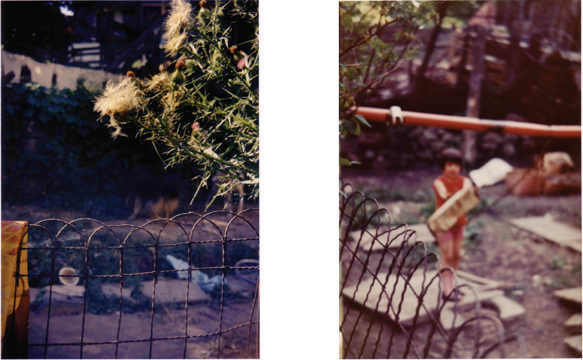
Tall and decorous, the house where I grew into adulthood stands iconic in my mind and my artistic output. It has become a symbol of home, family and a reconstructed past that hopelessly intertwines the truth and fiction of how things were and how I wanted them to be. A Narrow World, is a collection of photographs which explore the garden space of my childhood home at 56 Elm Street. I spent a lot of time in the Elm Street garden, initially as a place of play and elementary exploration with my brother Michael. We would devise ever more imaginative and impossible deaths for our toy soldiers throughout the garden and we had an insatiable desire to see what monsters and mysteries lurked in the darkness beneath its rocks. We were allowed to experiment with rudimentary gardening, each getting a package of seeds to plant. The successes of pole beans and zinnias encouraged further youthful experiments and offered me a sense of the earth’s cycles. I was a curious child; always inspired to learn something new or try something I had read about. I was only temporarily disappointed by failure and encouraged by success.  The garden became one of the first projects where I tried to impose my vision upon something and as such became vital soil for the nurturing of my art education. ...


The remainder of the essay can be found in the book.


A NARROW WORLD - No. 8 - Three Structure for Capturing Light
3 color photographs, each 5" x 7"


A NARROW WORLD - No. 2 - Migration
 color photographs, 5" x 7"


A NARROW WORLD - No. 13 - What Keep Us Separate
2 color photographs, each 5" x 7"


A NARROW WORLD - No. 17 - Abandoned Room
 color photographs, 5" x 7"


The second essay is titled:

The Second New York Trip

I was bored with school by third grade. Every subject was too easy. While the class was working through our assigned primer at three pages a day, I had skipped ahead and read the entire book. I even mastered drawing 8’s, which had nearly kept me back in the second grade. Mrs. Maloney knew all of this. She knew just how her students were doing and what they were capable of.  Mrs. Maloney believed I had potential, which is why she had me tested for gifted classes. I wasn’t so sure. I hated tests. You had to remember things, which I didn’t do well. Knowing things was different.  You didn’t have to know something exactly for it to be right, but remembering things had to be exact. ...

The remainder of the essay can be found in the book.

THE SECOND NEW YORK TRIP - No. 1 - Crowd Control
3 color photographs, each 5" x 7"

THE SECOND NEW YORK TRIP - No. 3 - City Triton

color photographs, 5" x 7"

THE SECOND NEW YORK TRIP - No. 6 - Cloud Piercing
2 photographs, 7" x 14" overall


A NARROW WORLD book can be purchased from Amazon or from Curious Matter.