Showing posts with label Art House Gallery. Show all posts

10.9.24

 Errand Into The Maze


July 22 - September 23, 2016

Art House Gallery

Esperanza Cortes
Sky Kim
Paula Overbay
Gilda Pervin


Every seven years, the Athenians had to send seven young men and seven young women to Crete as a sacrifice for their having killed King Minos’ son Androgeus. Without the ritual, the Athenians would have suffered even greater strife in payment for Androgeus’ death. These youths were never heard of again. They were sacrificed to the Minotaur in the labyrinth at Crete. In the traditional myth of the Minotaur, Theseus was the hero who volunteered to free the Athenians from their fate. With the aid of Ariadne, who fell in love with him, Theseus was able to use a ball of twine she provided to navigate his way out of the labyrinth once he had successfully slain the Minotaur. 
 
In Martha Graham’s dance, Errand into the Maze, Graham moves the focus of the story of the Minotaur away from the hero Theseus and onto Ariadne. Ariadne, was a daughter of King Minos and also the Mistress of the Labyrinth. In her role as Mistress of the Labyrinth, she would dance the maze of the Minotaur. It is here in this Minoan myth that Martha Graham’s interest lies. Graham envisions Ariadne’s encounter with the Minotaur in the darkness of the labyrinth as the awakening of her sexuality and her journey into womanhood. The bull as Minotaur is a lunar symbol (because the curve of his horns resemble the crescent moon) and a symbol of male lust. This is where our exhibition Errand into the Maze takes its theme, from Ariadne’s awakening and the exploration of the unknown. The original 1947 program from the first performance of Graham’s work notes, “The action has its core in that errand-journey into the maze of the heart in order to face and do battle with the Creature of Fear. There is the accomplishment of the errand, the instant of triumph, the emergence from the dark.” The four artists of our exhibition each have created work that speaks to the theme of Ariadne and her experience in the labyrinth. 
 
Esperanza Cortés, with her pieces “Las Desaparecidas”, recalls the disappeared of the world who have lost their lives to the despotic. They symbolize the women lost to the maze and the dangers therein. In the context of the exhibition, they become symbols of Ariadne and her journey to enlightenment; through disappointment and loss to wholeness and strength. “Ojo – Debe Costar Un Ojo De La Cara”, created as an emotional reaction to the destruction of present world terrorism also serves as a nod to the destruction of life ordered by King Minos in the legend of the Minotaur; a disquieting reminder that acts of terrorism are not limited to our own turbulent times. These trials have unfortunately been part of the human story since the beginning of civilization.

Esperanza Cortes
Ojo - Debe Costar Un Ojo De La Cara
2010-2015
150 eye portraits, watercolor on paper, 6' diameter, size variable

 
Sky Kim’s labor intensive watercolors have the physical presence of the labyrinth. Through their leafy textures and forms, they recall the diversions of the garden mazes of the Renaissance. The negative spaces in each of the paintings, also engender notions of sexuality, recalling Ariadne’s personal journey.


Sky Kim
Untitled
Watercolor on paper
40 x 40 inches

 
Paula Overbay’s paintings, not only have the visual reminders of the maze, but they imbue the concept of the thread provided by Ariadne to Theseus as his means of return through the complicated passages of the labyrinth. Overbay used as her point of reference the legend of Penelope, who put off her suitors while waiting for Odysseus’ return by weaving a tapestry. Upon the completion of her work, she was to make her choice. But, what she wove during the day, she undid at night and thus staved off a remarriage until her husband’s return. So here the symbol of thread and weaving become intertwined with the maze.


Paula Overbay
Bee Line II
2011
acrylic on wood
16 x 16 inches


Gilda Pervin uses both the sexual imagery of Ariadne’s dance and the crossing pathways of the maze in her works. “Monologues” reminds us, through is expanse and variety, that every woman has her story to tell and each is important and individual. In her assemblages of twigs and other objects, she provides the complicated form of the twisting maze where we can lose our way as we take the wrong direction, when the surety of emerging into the light can turn sinister.


Gilda Pervin
Waiting For Dawn
burlap, acrylic paint, chinese chestnut, found objects
6 x 8.5 x 2.5 inches


The maze is not a straightforward symbol of the journey, either of darkness or of spiritual or sexual awakening. Whether we are encountering our personal monsters or seeking the New Jerusalem, the maze is more complicated by the fears that haunt us, or the tools we need for combat. It is an experience that we must live through and emerge transcendent from, if we emerge at all. As Ariadne knew, for each of us who traverse the dark halls to regain the light, there are those who are trapped in the dead ends.  
 
Arthur Bruso • Raymond E. Mingst 
Curators


29.8.23


The overlapping circles start out as golds on the edge and melt into oranges, reds, blues, greens, and then back to golds for the middle of the quilt. A bit of her daddy’s Sunday shirt is matched with Abigail’s lace slip, the collar from Hope’s graduation dress, the palm of Grace’s baptismal gloves. Trunks and boxes from the other place gave up enough for twenty quilts: corduroy from her uncles, broadcloth from her great-uncles. Her needle fastens the satin trim of Peace’s receiving blanket to Cocoa’s baby jumper to a pocket from her own gardening apron. Golds into oranges into reds into blues… She concentrates on the tiny stitches as the clock ticks away. The front of Mother’s gingham shirtwaist — it would go right nice into the curve between these two little patches of apricot toweling, but Abigail would have a fit. Maybe she won’t remember. And maybe the sun won’t come up tomorrow, either. I’ll just use a sliver, no longer than the joint of my thumb. Put a little piece of her in here somewhere.

Gloria Naylor, Mama Day (New York: Ticknor & Fields, 1988)


More Than Perfect

We’ve become accustomed to perfection; we expect it. Particularly in the manufactured goods we buy. Despite the occasional random note slipped into a new pair of trousers announcing that that particular garment was inspected by ‘Ann’ (or an anonymous number) we have no interest in whose hands assembled the object we bought. Instead, we’d prefer to assume that no human hands touched the item at all, that everything were made by machines.

Machines work tirelessly and predictably. What they’re programmed to do will be done and the first will look like the last. As consumers, we take this for granted in all commodities. We’re trained to look for flaws and reject any defect. Bad seams, uneven color, a nick or a dent— it goes back to the store for replacement or a refund. We’ve even extended this mania for perfection to our food. We will not buy spotted apples or oranges that aren’t brightly consistent. This makes the work of an artist especially difficult. Increasingly, the artist is expected to compete with the slick results of machine manufacturing. 

An impeccable line is favored above the idiosyncratic hand of the maker. The variance that occurs from hand applying a color is considered a clumsy mistake. We want what an artist does to look like a product. In some contemporary art practices, this is exactly what is done. The object is created in a way that emulates manufacturing methods and reduces the evidence of the individual in order that the object can be more saleable.

The exhibition 3: Patricia Dahlman, Robyn Ellenbogen, Julie McHargue, goes against the current towards glistening, corporatized fabrication. It is not only an appreciation for the handmade in art, but a paean to craftsmanship. Patricia Dahlman uses sewing as another way to draw. “I sew marks with thread that one might make using pencil or paint. I like the surface, light and the feel of an embroidery that you get in a sewn drawing.” Her large hanging fabric sculpture, “Figure in Red,” harkens to a three-dimensional Stuart Davis painting. The colored shapes are ostensibly figurative, but it is the relationships of the colored shapes as they move in space that is the true idea of the piece. In talking about her use of materials Dahlman says, “I want to get to the idea rather than deal with a more complicated working process such as welding or making ceramics.”


Robyn Ellenbogen’s “Particular and Absolute” is as much an environment as a sculpture. Its cloud of multi-colored circle modules of sewn paper, hanging in the air, forms a dense, kinetic energy. Like the color interactions of Hans Hofmann, their presence changes the energy of the space and our perception of the environment. For Ellenbogen, “the sewn paper constructions evolved as a means of experimenting with the light.” Family tradition also inspired her interest in sewing as a medium. “My mom was a stellar seamstress and her interest in sewing dresses introduced me to a rich world of textiles and tactile sensation.”


Julie McHargue learned Appalachian traditions of sewing and quilting from her grandmother. “I would spend weekends with [her] as a child. She would show me how to make patterns, sew doll clothes and piece together quilt patterns from tiny scraps of fabric. Her house was small and simple in a rural community of around 500 people. She came from the hills of Kentucky and raised 12 children. She taught me…the depression era mind-set of using everything and wasting nothing. When I sew I feel her and my heritage.” McHargue’s series of six fabric panels wed Folk Art tradition with the compositional and color brevity of Kazimir Malevich. Each panel stands alone as an elegant work, but as a series it is possible to trace the progress of the theme as it expands and contracts from one panel to the next. This
creates an active, living work.


Dahlman, Ellenbogen and McHargue create potent works that celebrate the artist’s hand and stretch our ideas of what can be achieved through sewing and the sewn line. While their work transcends the domestic realm, we also attest that it honors the significance of the traditions from which they draw. Sewing, quilting, crochet are enmeshed in our histories and women have most often safeguarded this heritage. Through their art practices, Dahlman, Ellenbogen and McHargue assert the value of the craft in their work and point a way to the future of these traditions as expressed through contemporary art.

curators

8.4.22

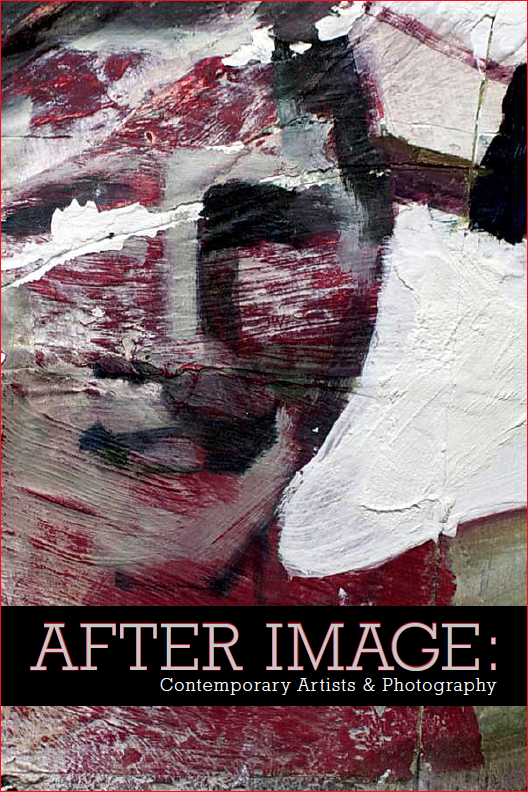
 After Image

Contemporary Artists & Photography


However the image enters
its force remains within
my eyes
rockstrewn caves where dragonfish
evolve
wild for life, relentless and acquisitive
learning to survive
where there is no food
my eyes are always hungry
and remembering
however the image enters
its force remains...
Audre Lorde,
Afterimages, (1981)

April 4 - May 29, 2015

The first photographers were inventors, scientists or those mechanically inclined—the grinding of lenses and the chemical processes were often of more interest to them than the artfulness of the images created. Artful or not, it was immediately apparent how extraordinarily effective photography was at depicting with accuracy the world in front of the camera. Artists became captivated by the new technology. They could easily record a portrait, a view, or a moment in time and revisit it as reference material for their work. Edgar Degas was among the 19th century painters who embraced photography. It’s possible to infer the influence of the technology on his painting from the cropped figures and framing of his subjects.
Edgar Degas, A Ballet Seen from the Opera Box, c. 1884,
pastel on paper, 25.75 x 19.875 inches.

Ever since Nicéphore Niépce, Hércules Florence and Henry Fox Talbot developed fixable photography in the 19th century, there has been debate whether the medium could evolve beyond its use as a documentary tool. The Pictorialism movement of the late 1800s to early 1900s aimed to bring respect to photography as an art form. Pictorialist works would often be soft focus, toned images with the surfaces enhanced to mimic qualities of drawing or engraving. Edward Steichen was a Pictorialist who had trained as a painter. Along with Alfred Stieglitz he opened the Little Galleries of the Photo-Secession. The gallery and Stieglitz’ magazine Camera Work actively promoted photography as a fine art. 

As a young man, Paul Strand visited Stieglitz’ gallery and was inspired by the Pictorialists. Strand later introduced greater abstraction into his compositions and has been credited with bringing Modernism into photography in the 20th century. Alfred Stieglitz followed soon after with his “Equivalents” series, which he insisted were equivalent to the abstract paintings of Wassily Kandinsky. By the 1960s, Vito Acconci was using photography as a means to convey his conceptual ideas of time and space, while Robert Rauschenberg was blanketing his work with photo transfers devising a photomechanical texture the content of which had little to do with the meaning of the work itself. 

Artists have actively engaged with photography in innovative ways since its invention, but it wasn’t until the 1970s that Sam Wagstaff, mentor to Robert Mapplethorpe, changed how it was perceived and valued as art. Wagstaff recognized that photography was undervalued.He began to collect American, British and French photography from the 19th century and eventually amassed an extraordinary collection. He is credited with establishing the modern market for collecting fine art photography. Previously, photography careers had been almost exclusively tied to the media—journalism and advertising. The collecting world had finally caught
up to Pictorialist assertions.

It was the Postmodern 1980s that saw an increased number of visual artists trained as painters fully embracing photography as a medium. Cindy Sherman staged her photographs and challenged the primacy of documentary, fashion and other types of photographic conventions. Jan Groover began juxtaposing images that together had more meaning than a single photograph. At the same time, there was a rise in interest in antique processes, inexpensive cameras and the distortions they made, and prints that would have made Ansel Adams weep with despair. 

Photography now is more simple and accessible than ever. With our camera phones at the ready we’re all perpetual image makers and sharers. We’ve gone from the alchemical dimness of “View From the Window at Le Gras”— the oldest surviving camera photograph, by Nicéphore Niépse, c. 1826—to the vivid, relentless static of our social media feeds. 

After Image is showcasing visual artists who are celebrating the photographic image, but are using it in ways that expand it as an expressive medium and are forcing it to conform to their idea of what a photograph can be. 

Returning to the beginnings of mechanical reproduction in art, Marsha Goldberg, “Smoke Billows from the Scene of a Blast in Bagdad,” and Joey Parlett, “Manassas,” render it back into a unique work of art through carefully distilling the photographic tones into a drawing. 

Nina Meledandri, “#915-3852,” and Kirsten Nash, “Bouquet Installed with Print Display,” find a conceptual relatedness between photography and painting by juxtaposing painting with the photograph, each informing the other and creating new meaning for both. 

Ross Bennett Lewis, “Missing,” like Sherrie Levine, takes a photograph of photographs. Lewis transforms the portraits of victims of 9/11 into a memento mori, a still life of a tragic moment of loss.
 
Nicéphore Niépce, View from the Window at Le Gras, c. 1826, photograph on pewter
plate, 6.4 x 8 inches. Below is a version enhanced by Helmut Gernsheim, c. 1952.


Bill Westheimer, “Las Vingeles” takes a small edge of a photograph and by enlarging it to extreme proportions, evokes surreal, panoramic landscapes that cause us to question our idea of place. 

Mary Pinto, “Plant,” Brett Wallace, “Organic #1” and Julie McHargue, “AP 1” to “3,” use the photograph for its color and texture to build three-dimensional objects that transforms the static source material into something visually kinetic. 

Julia Rooney, “I did a series in very hot August,” and Dennis Santella, Untitled, from “Electric Dreams,” explore the plethora of images that have inundated our lives with the popularity of the internet and digital photography. Rooney co-opts the low-resolution screenshots from Skype conversations and transforms them into oil sketches, imbuing them with more personality and meaning than was apparent in the small, deadpan digital captures. Santella explores our increasing fascination with technology and images by capturing a bit-mapped still from a digital video transmission and questions the information our culture is currently receiving. 

Emmy Mikelson, “Elevation no. 24,” takes us directly into the future with her non-object image. The idea of the tangible photograph as an object has been replaced by an image that exists only in digital space. No need for permanence at all, except for the saving of an electronic file. 

Each of the artists in After Image are deconstructing the idea of what a photographic image can be, rebuilding it into something new. By inputting their unique talent into these works, we discover that image making has a means of expression as rich and mutable as painting and sculpture. The photograph serves the visual artist as another powerful weapon in their arsenal of expression.

Arthur Bruso
Raymond E. Mingst
Curators


Artists


 This exhibition was our inaugural exhibition as curators of Art House Gallery in Jersey City.