Showing posts with label photo-based art. Show all posts

8.4.22

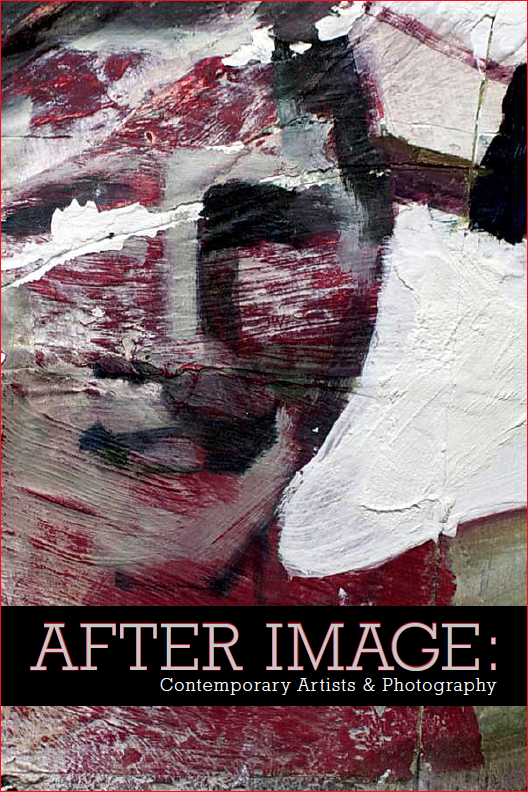
 After Image

Contemporary Artists & Photography

However the image enters
its force remains within
my eyes
rockstrewn caves where dragonfish
evolve
wild for life, relentless and acquisitive
learning to survive
where there is no food
my eyes are always hungry
and remembering
however the image enters
its force remains...
Audre Lorde,
Afterimages, (1981)

April 4 - May 29, 2015

The first photographers were inventors, scientists or those mechanically inclined—the grinding of lenses and the chemical processes were often of more interest to them than the artfulness of the images created. Artful or not, it was immediately apparent how extraordinarily effective photography was at depicting with accuracy the world in front of the camera. Artists became captivated by the new technology. They could easily record a portrait, a view, or a moment in time and revisit it as reference material for their work. Edgar Degas was among the 19th century painters who embraced photography. It’s possible to infer the influence of the technology on his painting from the cropped figures and framing of his subjects.
Edgar Degas, A Ballet Seen from the Opera Box, c. 1884,
pastel on paper, 25.75 x 19.875 inches.

Ever since Nicéphore Niépce, Hércules Florence and Henry Fox Talbot developed fixable photography in the 19th century, there has been debate whether the medium could evolve beyond its use as a documentary tool. The Pictorialism movement of the late 1800s to early 1900s aimed to bring respect to photography as an art form. Pictorialist works would often be soft focus, toned images with the surfaces enhanced to mimic qualities of drawing or engraving. Edward Steichen was a Pictorialist who had trained as a painter. Along with Alfred Stieglitz he opened the Little Galleries of the Photo-Secession. The gallery and Stieglitz’ magazine Camera Work actively promoted photography as a fine art. 

As a young man, Paul Strand visited Stieglitz’ gallery and was inspired by the Pictorialists. Strand later introduced greater abstraction into his compositions and has been credited with bringing Modernism into photography in the 20th century. Alfred Stieglitz followed soon after with his “Equivalents” series, which he insisted were equivalent to the abstract paintings of Wassily Kandinsky. By the 1960s, Vito Acconci was using photography as a means to convey his conceptual ideas of time and space, while Robert Rauschenberg was blanketing his work with photo transfers devising a photomechanical texture the content of which had little to do with the meaning of the work itself. 

Artists have actively engaged with photography in innovative ways since its invention, but it wasn’t until the 1970s that Sam Wagstaff, mentor to Robert Mapplethorpe, changed how it was perceived and valued as art. Wagstaff recognized that photography was undervalued.He began to collect American, British and French photography from the 19th century and eventually amassed an extraordinary collection. He is credited with establishing the modern market for collecting fine art photography. Previously, photography careers had been almost exclusively tied to the media—journalism and advertising. The collecting world had finally caught
up to Pictorialist assertions.

It was the Postmodern 1980s that saw an increased number of visual artists trained as painters fully embracing photography as a medium. Cindy Sherman staged her photographs and challenged the primacy of documentary, fashion and other types of photographic conventions. Jan Groover began juxtaposing images that together had more meaning than a single photograph. At the same time, there was a rise in interest in antique processes, inexpensive cameras and the distortions they made, and prints that would have made Ansel Adams weep with despair. 

Photography now is more simple and accessible than ever. With our camera phones at the ready we’re all perpetual image makers and sharers. We’ve gone from the alchemical dimness of “View From the Window at Le Gras”— the oldest surviving camera photograph, by Nicéphore Niépse, c. 1826—to the vivid, relentless static of our social media feeds. 

After Image is showcasing visual artists who are celebrating the photographic image, but are using it in ways that expand it as an expressive medium and are forcing it to conform to their idea of what a photograph can be. 

Returning to the beginnings of mechanical reproduction in art, Marsha Goldberg, “Smoke Billows from the Scene of a Blast in Bagdad,” and Joey Parlett, “Manassas,” render it back into a unique work of art through carefully distilling the photographic tones into a drawing. 

Nina Meledandri, “#915-3852,” and Kirsten Nash, “Bouquet Installed with Print Display,” find a conceptual relatedness between photography and painting by juxtaposing painting with the photograph, each informing the other and creating new meaning for both. 

Ross Bennett Lewis, “Missing,” like Sherrie Levine, takes a photograph of photographs. Lewis transforms the portraits of victims of 9/11 into a memento mori, a still life of a tragic moment of loss.
 
Nicéphore Niépce, View from the Window at Le Gras, c. 1826, photograph on pewter
plate, 6.4 x 8 inches. Below is a version enhanced by Helmut Gernsheim, c. 1952.


Bill Westheimer, “Las Vingeles” takes a small edge of a photograph and by enlarging it to extreme proportions, evokes surreal, panoramic landscapes that cause us to question our idea of place. 

Mary Pinto, “Plant,” Brett Wallace, “Organic #1” and Julie McHargue, “AP 1” to “3,” use the photograph for its color and texture to build three-dimensional objects that transforms the static source material into something visually kinetic. 

Julia Rooney, “I did a series in very hot August,” and Dennis Santella, Untitled, from “Electric Dreams,” explore the plethora of images that have inundated our lives with the popularity of the internet and digital photography. Rooney co-opts the low-resolution screenshots from Skype conversations and transforms them into oil sketches, imbuing them with more personality and meaning than was apparent in the small, deadpan digital captures. Santella explores our increasing fascination with technology and images by capturing a bit-mapped still from a digital video transmission and questions the information our culture is currently receiving. 

Emmy Mikelson, “Elevation no. 24,” takes us directly into the future with her non-object image. The idea of the tangible photograph as an object has been replaced by an image that exists only in digital space. No need for permanence at all, except for the saving of an electronic file. 

Each of the artists in After Image are deconstructing the idea of what a photographic image can be, rebuilding it into something new. By inputting their unique talent into these works, we discover that image making has a means of expression as rich and mutable as painting and sculpture. The photograph serves the visual artist as another powerful weapon in their arsenal of expression.

Arthur Bruso
Raymond E. Mingst
Curators


Artists


 This exhibition was our inaugural exhibition as curators of Art House Gallery in Jersey City. 


4.8.11

Falling City

My latest solo exhibition:

Falling City 
                      Arthur Bruso

July 31 - August 28 2011
Curious Matter
272 Fifth Street, Jersey City NJ

MY DEATH - No. 14 - Board Fortress
photograph 8"x10"


Falling City is an exhibition of 25 of Arthur Bruso’s photographs. The images in this collection have a fleet quality–they seem casual, unstudied, even random. A passing face on the street captured in a blur reveals a mutual awareness between the subject and the photographer, but the reverie of the moment isn’t interrupted. Abandoned properties, textural details of wood-sided buildings weathered, degenerate and ready for bulldozing are regarded with the same placidity. Initially, the individual photographs seem mundane, but that’s deceptive. Collectively it becomes clear that the glancing quality is not arbitrary. They subtly gain momentum and a unique point of view is revealed. 


ON THE STREET - No. 3 - Missed Message
c-print, 8" x 10"


When I sat down with Bruso to interview him on the occasion of his solo exhibition “Aether: constructions and photograms” in 2008–a show I curated–he brought up Lillian Hellman to articulate an aspect of his work of which I’m particularly captivated.

Bruso: Lillian Hellman talks about pentimento in relation to a person’s past. Pentimento is an art conservation term that describes the effect of oil paint becoming more transparent over time, allowing the changes the artist made to show through. Hellman uses the term to explain her way of looking back over a life and reconsidering it with the knowledge and wisdom of the present (“to see what was there for me once, what is there for me now.”) For me, my art exists in a continuum. The “Into The Magic Space” film may have been exposed when I was a teenager, but revisiting [the work] after [many years] changed my approach to the images.


MY DEATH - No. 6 - Not Needed
photograph, 10" x 8"


As I was curating Falling City perhaps it was because I had the Hellman reference in mind that I thought of another anecdote from the writer’s life. I recalled Mary McCarthy wickedly declaring of Hellman, “every word she writes is a lie, including ‘and’ and ‘the’.” I pondered the quote in relationship to Bruso’s photographs and thought perhaps it was apt. Not as a rebuke, or to taunt a lawsuit such as Hellman took out against McCarthy because of the comment, rather in the sense of an artist commanding their material to serve a vision beyond that of mere data. While we can wonder about Hellman’s self-mythologizing and self-invention; we may also question how relevant that is in the face of her literary achievement. Any story can be imagined a lie, limited or shaped by point of view, and with Bruso’s photos we may never know the full documentary truth. Bruso embraces a medium that continually teases us to question where? when? who? yet these questions are merely a red herring in contemplating his work. Certainly there are clues within some of the images that reveal a timeline: a hairstyle, a landmark. Bruso doesn’t set out to erase time and place, however these simply aren’t the distinguishing themes. Falling City suggests a narrative but it’s as hazy as some of the passing faces his camera captures. The play between stillness and motion, studies in texture and glimpsed scenes generate a rhythm that mimics “looking” as opposed to image making. The artist actively considering his environment is apparent. There’s an immediacy and sketchbook-like quality that’s potent and lively, achieved by trusting the world to reveal itself to a democratic eye.


ON TH STREET - No. 1 - Push
c-print, 8" x 10"


Bruso utilizes his photographs as an ever-expanding vocabulary. He has an almost encyclopedic collection from which to draw. Since his first camera he never stopped taking pictures. There are images taken during boyhood explorations in the woods, others are experiments from student photo classes, others are more recent. From this visual history he’ll reprint and reconsider, sometimes juxtaposing or repeating images to communicate new ideas. Every photograph he takes becomes part of an on-going investigation and meditation. The images are not about dramatic, decisive moments, but rather an accumulation of observations. They are instances that might otherwise go ignored. Bruso identifies something compelling in the everyday. William Eggleston similarly embraced the mundane, but if Eggleston is comparable to cinematography with his vibrant color and unusual compositions, Bruso is the intimacy of a home movie. One image is captured on the fly while another is carefully composed. Some images are black and white; others have a color palette muted by a combination of age and darkroom intention. The work remains in flux because he is continually reevaluating. “What I thought were failures then, look new and interesting now.” Perhaps the task he has set for us is to decide what greater truth is being revealed, one that doesn’t rely on facts, dates and names, or even the decisive moment but on communicating something even more fundamental, more essential and which only becomes apparent by looking again and again. 


Raymond E. Mingst, curator

Used by permission of Curious Matter

7.6.10

THE BITTER WATER OF LETHE – No. 5 – Consecrated Ground

  THE BITTER WATER OF LETHE – No. 5 – Consecrated Ground
photograph with hand color, 8" h. x 10" w.

We fear death. Not just death, but corpses, burials and burial grounds too. Every culture has evolved rituals, taboos and superstitions regarding death. The idea of the spirit illuminates the difference between life and death. And, it is the fate of the spirit or soul that confounds us.
    One common fear across cultures is the return of the spirit after death. Many rites have been created to keep the dead in their grave or to assist in guiding the soul to the Otherworld. In my work, THE BITTER WATER OF LETHE – No. 5 – Consecrated Ground, the photograph depicts a simple gravesite in a neglected cemetery. It is surrounded by a gas pipe fence draped with chain, and planted with daffodils. The Victorians were fond of erecting fencing around the family plot. In a community cemetery, this had the advantage of demarking the space allotted for interments and visitors could easily recognize that all of the interred were related. It also had the function of keeping out vandals and animals. But fencing around the grave has another aspect aside from the practical; iron is believed to repel, or contain ghosts. An iron fence will keep the spirit of the dead from wandering. The gas pipe fencing in my photograph not only outlines the size of the area, it also serves this supernatural purpose.
    The draped chain too, is symbolic. As a decorative element, it alludes to the bunting used to decorate the home, carriage and casket during a funeral. It also suggests chaining the deceased to heaven, another way of guiding the dead to the Otherworld, and away from the earthly plane.
    Daffodils have been planted on graves since the ancient Greeks. The bulbs are slightly poisonous. They were the flower that enticed Persephone, allowing Hades to snatch her to the Underworld. For these reasons, daffodils have been associated with burials and graves. Even their Latin name, Narcissus, alludes to death as sleep.
    In my photograph, the humbleness of the pipe fence and the absence of markers evidence the families’ financial status. But it suggests something more. Outlined as a private gravesite, but without headstones suggests the area is somehow more important than the individuals buried there. This captured my imagination, along with the subtle symbolism of the funereal elements. It is my intent in this image, to make the space inside of the fence different; to make visible, the invisible aura of the Otherworld.
    The finality of death is difficult. In our efforts to understand and accept, we create rituals to honor those who have been laid to rest and endeavor to make their slumber comfortable as they await the call to their final reward. Yet, as much as we mourn the passing of an individual, we fear that their soul will not heed that call. So, we the living strive to ensure that the road to glory is clear, and there isn’t a return path. - A.B.

THE BITTER WATER OF LETHE - No. 5 - Consecrated Ground was part of the exhibition 
The Ecstatic at Curious Matter, May 16 - June 13, 2010

19.3.10

An Adolescent's Appropriation of Eliot Porter images

An Adolescent's Appropriation of Eliot Porter, is the second series of work featured in my book Structure of the Church.

Here is the first paragraph of the essay that discusses the work:

Stella O’Conner moved into the first floor apartment of our Elm Street house, taking over the apartment that had been vacated following my great-grandmother’s death. Stella was a friend of my mother. She lived alone, had no children and had a marriage that ended in divorce. Her husband had been an alcoholic. Stella’s life had not been easy and she was known to bemoan its tragic story to any sympathetic ear.


Selected images from the series:

AN ADOLESCENT"S APPROPRIATION OF ELIOT PORTER - No. 7 - Channeling a Diminishing Energy
color photograph with hand color


AN ADOLESCENT"S APPROPRIATION OF ELIOT PORTER - No. 8 - Subtraction


AN ADOLESCENT"S APPROPRIATION OF ELIOT PORTER - No. 9 - 
Passing Through a Telluric Portal
 The book Structure of the Church, is available from Amazon or from Curious Matter.

16.3.10

Structure of the Church images

Structure of the Church is the first series in my book Structure of the Church. Here is the first paragraph of the essay that explains the work:

In 1888 when its second spire was completed, the Cathedral of the Immaculate Conception dominated the Albany skyline. For ninety years it was one of the most recognizable landmarks in the city, proudly commanding the side of Madison Avenue hill at Eagle Street, until the Empire State Plaza cast its shadow over it. The cathedral was built for the entire Catholic community of Albany. However, the Italian immigrants didn’t resonate to its imperious and sedate Gothic character. The Cathedral of the Immaculate Conception was dark and gloomy, more like a mausoleum than a living church. It was full of frightening shadows, which hid the statues placed high on the walls, making them distant and unreachable even to prayer.

Selected images from the series:


STRUCTURE OF THE CHURCH - No. 7 - The Space Beyond Heaven
photograph with hand color


STRUCTURE OF THE CHURCH - No. 8 - Following the Edge Between Solid and Spirit


 STRUCTURE OF THE CHURCH - No. 10 - How Religion Started


STRUCTURE OF THE CHURCH - No. 11 - Understanding the Form


The book Structure of the Church is available from Amazon and from Curious Matter.

17.2.10

Structure of the Church Book


Curious Matter is delighted to announce the publication of “Structure  of the Church” by Arthur Bruso.

This is the third in a projected series of four books that will contain more than 70 photo-based works of art along with an introduction and essays by the artist.


“Structure of the Church” is an intimate and engaging book. It is a unique document that distills the artist’s remembrances both visually, with images taken during his boyhood, and in the accompanying essays. The title work and “An Adolescent’s Appropriation of Eliot Porter” poignantly capture a sense of yearning and the early steps of a life of artistic inquiry.


The images used in “Structure of the Church” were originally created during the artist’s childhood explorations of his Albany, New York neighborhood. Bruso explains, “[This body of work] was born of a collection of photographs that I’ve been taking since I got my first camera as a boy. Over time the photos had acquired a sort of elemental quality. I was looking to distill them into symbols that could be formulae for my ideas. I reprinted the images, placed them together and began to see relationships. Those relationships informed and enlarged the meaning of the work. By placing the images in the context of one another, I was changing their meaning and creating a new language for my art, while the pentimento of my childhood remained.”


The accompanying essays present a portrait of an inquisitive boy and reveal through autobiographical details something of the artist Bruso would become. In the first essay and title work, “Structure of the Church”, Bruso retells his families’ “miracle story” wherein his grandmother, as a little girl, having been diagnosed an invalid, gains the ability to walk for the first time. The mysticism and folklore of his childhood are explored in the context of the turbulent times of the Catholic Church during Vatican II as experienced within a community of Italian immigrants who celebrated rituals and honored saints with processions and festivals. Bruso writes of “the dichotomy I experienced between the folk spirituality that surrounded me in my Italian community, and official doctrine that was moving away from the mystical.”


With the second essay, “An Adolescent’s Appropriation of Eliot Porter”, Bruso introduces Stella. She is one of a series of tenants to whom the Bruso family rented rooms in their large Victorian rowhouse. “...Albany had become a destination for young, post-WWI, rural New Yorkers (especially women) looking to escape the confines and drudgery of farm life in order to experience the excitement of city lights, along with the security of a state job.” Bruso was shy of these strangers living among his family, yet keenly observant. He tells of Stella’s generosity, and also her longing for a life that seemed to have slipped through her fingers. “Stella had tried to stop time at a place where she felt happy and life seemed promising; as a young bride before certain realities began to bear down.” Ultimately Stella was responsible for introducing Bruso to the work of Eliot Porter, a significant and enduring inspiration.


“Structure of the Church” is an intimate and engaging book. It is a unique document that distills the artist’s remembrances both visually, with images taken during his boyhood, and in the accompanying essays. The title work and “An Adolescent’s Appropriation of Eliot Porter” poignantly capture a sense of yearning and the early steps of a life of artistic inquiry. Bruso explains, “Photographs that I had previously decided were failures because they were out of focus, or banal or under-developed became more interesting.” In reexamining and presenting these images anew Bruso creates works potent in their humility.


Structure of the Church is available from amazon.com books, or from Curious Matter.

24.10.09

Cave


Cave, 5.5"h x 6.125"w x 4.75"d
gourd, coal, plastic, steel, steel wire, gouache, acrylic paint, archival board, wood, glass

Caves are hidden realms, having their own extreme geology and often their own unique biota. Some caves can even be considered living as they grow by the action of bacteria on their rocks. The bacteria dissolves the stone, and thus enlarges the space. As the place where precious stones and ores are found, and strange, frightening-looking animals dwell, the cave became the secret place of treasure, often guarded by a monster, spirit or nymph. Another precious commodity, water, is often traced back to the cave which is seen as the source of a river or spring.

Life-giving water and the possibility of wealth, versus dangerous conditions and darkness is the dichotomy of cave symbolism. The cave is both generative and a place of death. It is the womb of the earth and the entrance to the underworld. With the generative qualities of the womb, the cave is where the god Zeus was nurtured to keep his survival secret from his father Kronos. In this depiction, the cave becomes not only the nurturing womb, but also the secret place that keeps even the gods from seeing in. It may have been the notion of the earth womb that inspired prehistoric men to travel deep into caves to paint the animals they hunted on the walls, either to ensure an unending supply of food, or out of an understanding and respect of the powerful fecund forces of the animals themselves.

Viewed as entrances to the underworld, the cave takes on the negative aspects of death and dying. It is easy to become lost in a cave with its twisting route and total darkness. Thus, with the fear of a cave’s real ability to swallow up the soul into the bowels of the earth, it becomes viewed as the place where we go after death. No wonder Dante described the entrance to Hell as a cave with a message to abandon all hope.

In my construction, Cave, I envision both the womb and the underworld. The two forces are a balance of powers. There can be no birth without death. The cycle perpetuates.


Cave was part of the exhibition Nyktomorph at Curious Matter, 
September 20 - October 18, 2009

11.9.09

Nyktomorph


I am participating in the group exhibition Nyktomorph at Curious Matter. It runs September 20 - October 18, 2009.  The following artists are also showing work:


Carrie-Ann Bracco
Arthur Bruso
Suzan Courtney
Peter H. Everett
Edward Fausty

Conor Fields
Jimmy Fike
Richard Haymes
Ricardo Hernandez
Mary Hill
Kay Kenny
Yvonne Piner Kleiman
Ross Bennett Lewis
Luis Locarno
Joan Mellon
Raymond E. Mingst
Christopher Moss
Brian Oakes
Franc Palaia
R. Wayne Parsons
Olivié Ponce
Owen Rundquist
Stacy Seiler
Cedric Yhuel


Here is the first paragraph of the catalog essay.

And now, as the night was senescent, 
And star-dials pointed to morn–
 
As the star-dials hinted of morn–
 
At the end of our path a liquescent
 
And nebulous lustre was born,
 
Out of which a miraculous crescent
 
Arose with a duplicate horn–
 
Astarte’s bediamonded crescent
 
Distinct with its duplicate horn.
 
excerpt from “Ulalame” 
by Edgar Allen Poe, 1847

From out of the nebulous light, at the end of a path, Edgar Allen Poe describes the appearance of the goddess Astarte. Here, she is an imagined figure of the night, or what’s called a nyktomorph. In darkness, when forms blend into one another and color is suppressed, our minds can create entire fantasies out of the shadows we encounter. Our inclination is to evoke something to make sense of what we can’t clearly see. But this impulse isn’t merely intellectual, the enveloping mystery of the twilight adds an emotional dimension—often fear and wonder—which lends these conjured figures and scenes a fantastical quality.


To read the rest of the essay, please go to the Curious Matter site. The catalog is available from Lulu.com.

7.7.09

A Lesser Doxology - photographs

Untitled (sun mirror)
8" x 10"
photograph


Rising Light
16" x 10" overall
photograph


Untitled (circles)
8" x 20" overall
photograph


There are 9 photographs on view in A Lesser Doxology. Here is a sample of them.

5.7.09

A Lesser Doxology - box constructions

Asteriod
7" x 5.5" x 3"
steel, acrylic resin, golf ball, stone, wood, acrylic paint
, glass


Galaxy
6.6" x 6.5" x 4"
nickel plated brass, gold plated brass, glass crystal, plastic, steel wire, archival mat board, cardboard, rag paper, acrylic paint, glass


A Lesser Doxology has two components, box constructions and photographs. There are four box constructions in the exhibition. Here I show two. As suggested by the titles, these have cosmological themes.

2.7.09

A Lesser Doxology

My new solo show opens at Curious Matter on July 5, 2009 and runs through August 30, 2009.

Raymond E. Mingst has written an essay about the work in the show. Here is the first paragraph:

As it was in the beginning, is now, and ever shall be, world without end,” is from a statement of praise known as the ‘lesser doxology’ which is repeated during the Christian liturgy. Arthur Bruso’s new exhibition of photographs and constructions touches on that sense of the eternal, and our perpetual search to find meaning and elegance in a patient universe. Bruso explains, “cosmological themes lend themselves to conceptual interpretation because of the nature of Physics. Most of what we know about the universe comes from mathematical models, not direct observation like much of Biology.”

Please go to the Curious Matter site to read the complete essay.

5.5.09

Nebula


Nebula
cotton string, polyester patch, wax, monofilament, archival board, wood, acrylic paint,
tissue paper, glass
4 7/8"h. x 6 3/8”w. x 2 7/8”d.

From the Greek meaning “cloud,” nebulae are clouds of gases, dust particles and plasma drifting through space. The various states of matter in the clouds have a gravitational attraction to each other and often coalesce into stars or other space bodies. For this reason, they are considered to be incubators for astronomical objects. Not all nebulae give birth to stars however. Some are the remnants of super nova and thus are the last vestiges of stars before they snuff out.

Nebula, concentrates on the creation aspect of these interstellar clouds, with the string representing the gas and particles. Toward the back of the box is a dark colored star shape which is the birth of a new space object.

Although I do not peer through telescopes tracking the vastness of space, I am intently interested in cosmology for the magnitude and mysteriousness of the processes that unfold in the universe. I see a connection with the natural physical mechanism of the universe and, mythology and magic. It is this shadowy area where human experience and imagination converge that inspires my visual ideas.


Nebula was exhibited in Poison at Curious Matter, April 5 - May 17, 2009.

4.5.09

Poison


I participated in the group exhibition Poison at Curious Matter, on view from April 5 - May 17, 2009 with the following artists:

Aica
John Belardo
Arthur Bruso
Carrie Fucile
Christy Georg
Andrew Graham
Gail Goldsmith
Lee Johnson
Kay Kenny
Kevin A. Kepple
Ross Bennett Lewis
Kenric McDowell
Raymond E. Mingst
Jeanne Mischo
Sarah Pfohl
Matt Pych
Kara Smith
Kikuko Tanaka
P. Teramode
Kelly Vetter
Kimberly Witham
Brandy Wolfe


Following is the first paragraph of the catalog essay which explains the theme:


When the desire to find a passive, sophisticated method of eliminating undesirable people becomes a consideration, poison has captured the imagination for millennia. It appears in folk tales, fairy tales, opera and murder mysteries. Poisoning has become the clean, classic way evil characters subdue and eliminate a rival without the use of brute force. Historically, there have been many instances of poisoning to clear the way to a throne, a court position or an inheritance. Lucrezia Borgia gained her notoriety as a Renaissance beauty who seduced and then subsumed several gentlemen who stood in the way of her brothers strivings for power. But poison is not just a substance used to remove inconvenient competition. Curious Matter explores the different ways artists respond to this concept.

The entire essay may be read at Curious Matter. The Poison catalog is available from lulu.com.

1.5.09

The Line Holds, the Space Beckons book


Curious Matter is pleased
to announce the publication of


THE LINE HOLDS,
THE SPACE BECKONS


by Arthur Bruso

THE LINE HOLDS, THE SPACE BECKONS reproduces 26 photo-based works from
two collections by the artist, On the Steps Out the Window and Looking at Seeing.

The book is available from Amazon.com or,
directly from Curious Matter.

This is my second publication.
Also by Arthur Bruso: Into the Magic Space

30.4.09

Looking At Seeing

The 11 pieces collected in this body of work, celebrate basic design concepts. These concepts provide infinite flexibility, and transcend time. Looking at Seeing suggests different ways of looking at the familiar.

LOOKING AT SEEING - No. 3 - The Finite and Infinite in Direction
photograph
10" x 5" overall


LOOKING AT SEEING - No. 9 - Darkness Conquers Light
photograph
34" x 7" overall

29.4.09

On the Steps Out the Window

On the Steps Out the Window, is a series of 15 photographic artworks that explore the space of my childhood. These are scenes that I saw everyday out of the windows, in the rooms, in the garden and about the surrounding landscape. With this body of work I am asking: how does this geography inform my thinking and my art; the change over time, the evolving culture, how does it make its mark? The answers plot the external and the internal space that surrounded me, both as a nosy child and as a questioning adult.


ON THE STEPS OUT THE WINDOW - No. 1 -
The Line Holds, the Space Beckons

15" x 7" overall
photograph


ON THE STEPS OUT THE WINDOW - No. 11 - Omen of Loss
5" x 7"
color photograph

28.4.09

The Alchemist's Garden: Perses

The Alchemist's Garden: Perses
24" h. x 8" d.
mahogany, copper, brass, bloodstone, hematite, oil paint, acrylic paint, varnish

The Titans, in the ancient Greek cosmology, ruled the sky and the forces of nature before the Olympian gods. They were personifications of the processes of the universe. Perses was a third generation Titan, whose father Krios was the south pillar of the dome of the sky and whose mother Eurybia was master of the sea. Krios, as one of the bearers of the cosmos, is associated with the modern constellation of Aries, which rises in the southern part of the sky, north of the equator. He had three sons: Astraios, Pallas, and Perses.

Perses, whose name translates to “destroyer,” is the personification of the destructive force of the universe. If a star explodes in the heavens, that would be Perses work. If something falls from the sky and causes havoc on earth, that is Perses as well. On earth, his influence was most often felt through the droughts and tempests of late summer which could devastate crops just before they were ready for harvest, inviting Limus (famine) and Oizys (misery). He could also play with the mind and temper of man, by bringing on feelings of warring, pillaging and rampage, laying waste to villages, societies and culture. His power was only relieved by his brother, Astraios who has the calmest personality of Krios’ sons and was father to the four winds.

Perses’ wife was Asteria whose name translates to “star.” She was herself a Titan who controlled prophetic dreams, oracles, astrology and necromancy. Together, they had a daughter, Hecate, goddess of witchcraft. (Destructive power paired with fortune telling yields black magic)

This sculpture, The Alchemist’s Garden: Perses, depicts the destructive power of Perses as a burst or explosion at the summit of a globe. The globe is a representation of the universe with the stars of heaven on the top hemisphere and the fires of earth on the lower, surrounded by the signs of the zodiac, representing the wheel of the year and the boundaries of the cosmos. The burst contains hematite and bloodstone, both minerals that are associated with power. Bloodstone is thought to bring on tempests for the use of the bearer and hematite is thought to provide strength in battle to the wearer.

As the parents of Hecate and as Titians who control two of the fundamental energies of the magical arsenal, Perses and Asteria have a niche at the bottom of my Alchemist’s Garden where wildness mingles with the shadows. The Alchemist’s Garden is an environmental project that explores the concepts, processes and elements of magic and alchemy through the landscape.

The Alchemist's Garden: Perses, was exhibited as a part of the Between Worlds exhibition at Curious Matter, September 14 - October 19, 2008. It was first exhibited at the Gallery-Studios open studios October 2006 as part of a larger project/installation, The Alchamist's Garden.

27.4.09

Between Worlds


I participated in the Between Worlds exhibition at Curious Matter which ran September 14-October 19, 2008 with the following artists:

Ali Aschman
Yiftach Belsky
Ryan Browning
Arthur Bruso
Peter H. Everett
Amy Finkelstein
Maureen Foster
Ronald Gonzalez
Michael Heroux
Yvonne Kleiman
Sebastian Lemm
Ross Bennett Lewis
Marianne McCarthy
Joan Mellon
Richard Metz
Raymond E. Mingst
Jeanne Mischo
Matt Pych
Carol Radsprecher
Brooke Rogers
Anthony Santella
Lisa Taliano
Kikuko Tanaka
Jamie Marie Waelchli
Alyssa Taylor Wendt
John J. Zirkelbach


Here is the introductory paragraph of the catalog essay:

There are locations in this world that have accumulated a reputation for existing outside the normal experience of a place. Whether through legend, rumor or fear, they are perceived to be an exchange point between the world of the senses and the extrasensory. These are the spaces claimed by no one, such as: the crossroads whose center belongs to no direction; the hedge, straddling the boundary of the tamed garden and the wilderness; and the threshold, holding the house from the greater world. In this exhibition, Between Worlds, the artists follow their curiosity into these amorphous realms that put our nerves on edge––existing on the boundaries of the known and unknown––and give us their vision of what they find there.

Please go to Curious Matter to read the complete essay. The Between Worlds catalog is available from Lulu.com

24.4.09

ÆTHER

The second component of ÆTHER at Curious Matter was the photograms. The photograms are all untitled and are composed of rubber toys, glass, crumpled waxed paper, spilled water, leaves and sticks. these objects are placed on photographic paper and exposed to light for a brief moment. The paper is then developed as you would a photograph.

The imagry is connected to the transparency or translucentcy of most of the materials and how that would translate to an image. Because the images seem other worldly or like outer space phenomon, they related well to the box constructions.


Untitled
4" x 4"
photogram


Untitled
3.25" x 3"
photogram


Untitled
3" x 6"
photogram


Installation of the photograms with the box constructions.


Installation shot of the photograms detailing the jars of found objects used in the box constructions, which were shown with the works.

23.4.09

ÆTHER

There were two components of my solo show ÆTHER at Curious Matter, photograms and box constructions. The box constructions are shown here. The box constructions incorporate found materials, arranged in a box structure. The theme for these constructions is the physical phenomenon of outer space.


Dark Matter
6" x 4" x 2"
cloth covered wire, cloth electricians tape, cardboard, rubber, steel ball, wood, oil paint, acrylic paint, steel wire, copper wire, glass


Installation of the box constructions.

Installation showing: Before the Big Bang, Pulsar and Wormhole (back)


Installation showing: Pulsar, Wormhole (front) and Black Hole


Installation showing: Black Hole and Comet